Best Stereo Amplifiers of 2026: Ranked by Real Demand and Value
Choosing a stereo amplifier is one of the most consequential decisions you will make for a two-channel or home theater setup, because the amp sets the ceiling on everything downstream. There are dozens of options at every price point, from sub-$20 class-D modules to $500-plus integrated units, and the differences between them are not always obvious from spec sheets alone. To cut through the noise, we ranked every amplifier in this guide using verified Amazon purchase data, review counts, and ratings of 3.8 stars or higher. Budget picks start at well under $50, mid-range options land between $75 and $140, and the premium tier runs to around $370 for the Yamaha A-S301BL and $300 for the WiiM integrated streamer-amp. Whether you are powering a bookshelf speaker pair in a bedroom, running background music through a commercial space, or building a serious two-channel listening room, there is a pick in this list that fits your use case and budget.
Top picks at a glance
Compare every pick
-
1 Pyle P3301BAT Amplifier $136.58
- Type
- Amplifier
- Channels
- 2.0
- Power
- 3000 W
-
2 Pyle PD3000BAH Amplifier $239.99
- Type
- Amplifier
- Channels
- 2.0
- Power
- 3000 W
-
3 Pyle PMSA126BU Amplifier $79.99
- Type
- Amplifier
- Channels
- -
- Power
- 500 W
-
4 Pyle PDA29BU.5 Amplifier $34.99
- Type
- Amplifier
- Channels
- 2.0
- Power
- 100 W
-
5 Pyle PDA7BU Amplifier $80.99
- Type
- Amplifier
- Channels
- 2.0
- Power
- 200 W
-
6 Moukey MK0101-US Amplifier $47.59
- Type
- Amplifier
- Channels
- 2.0
- Power
- 400 W
-
7 Pyle PDA69BU Amplifier $74.99
- Type
- Amplifier
- Channels
- 2.0
- Power
- 200 W
-
8 Donner MAMP5 Amplifier $98.79
- Type
- Amplifier
- Channels
- 2.0
- Power
- 110 W
-
9 WiiM Amplifier $299.00
- Type
- Amplifier
- Channels
- -
- Power
- -
-
10 Yamaha A-S301BL Amplifier $369.95
- Type
- Amplifier
- Channels
- -
- Power
- -
-
11 Pyle PTA66BT Amplifier $84.99
- Type
- Amplifier
- Channels
- 2.0
- Power
- 600 W
-
12 Pyle PDA77BU Amplifier $119.99
- Type
- Amplifier
- Channels
- 2.0
- Power
- 800 W
Best Stereo Amplifiers of 2026: Ranked by Real Demand and Value, ranked

- Channels 2.0
- Power 3000 W
- Connectivity Bluetooth, Usb, Rca
- Color Black
- Dimensions 16.9 X 3.5 X 11.8 In
The Pyle P3301BAT posted the highest verified monthly purchase volume in this entire category at 3,000 units per month, which is a hard signal of real-world demand that review manipulation cannot easily replicate. At $136.58 it offers a 2.0-channel layout with Bluetooth, USB, and RCA connectivity, a 3,000 W peak power claim, and dimensions of 16.9 x 3.5 x 11.8 in that fit a standard rack bay. Its 4.0-star rating across 1,168 reviews confirms that the consistent sales are not a fluke. For buyers who need a reliable, high-demand amplifier at a mid-range price, this is the benchmark.
Best for: Home, small commercial, or multi-use installs where high real-world demand signals reliability
Pros
- Highest verified monthly purchase volume in the category (3,000 units per month)
- Bluetooth, USB, and RCA inputs cover most source types
- Rack-friendly form factor at 16.9 x 3.5 x 11.8 in
- 4.0-star rating confirmed across 1,168 reviews
- Mid-range price at $136.58 for a feature-complete unit
Cons
- 3,000 W figure is peak, not continuous RMS output
- No HDMI or optical input for direct TV connection
Bottom line: The Pyle P3301BAT earns the top spot through sheer verified buyer demand and a consistent 4.0-star rating. It is the safe, proven choice at this price point.
Check price on Amazon Read the full review →
- Channels 2.0
- Power 3000 W
- Connectivity Hdmi, Bluetooth, Usb
- Color Black
- Dimensions 16.9 X 14.6 X 5.7 In
- Weight 22.78 lb
The Pyle PD3000BAH matches the P3301BAT on monthly purchase volume at 3,000 units but adds HDMI to its connectivity suite alongside Bluetooth and USB, making it a more versatile option when a TV or media player is part of the signal chain. At $239.99 it is the pricier of the two, but its 2,100 reviews at a 3.8-star rating reflects a much larger buyer base than most amps at this price. The chassis runs 16.9 x 14.6 x 5.7 in and weighs 22.78 lb, which places it solidly in rack-mount territory. Peak power is rated at 3,000 W across its 2.0-channel configuration.
Best for: Buyers who need HDMI connectivity alongside Bluetooth and USB in a high-demand, rack-style amplifier
Pros
- Tied for highest monthly purchase volume at 3,000 units per month
- HDMI input for direct TV or media device connection
- 2,100 reviews validate long-term buyer satisfaction
- Bluetooth and USB round out a complete connectivity set
- Heavy 22.78 lb chassis suggests substantial internal components
Cons
- 3.8-star rating is the minimum threshold for this list
- Higher price than the P3301BAT for similar peak power claim
Bottom line: The PD3000BAH is the go-to pick when HDMI connectivity matters and you want volume-of-purchases confidence behind your buy.
Check price on Amazon Read the full review →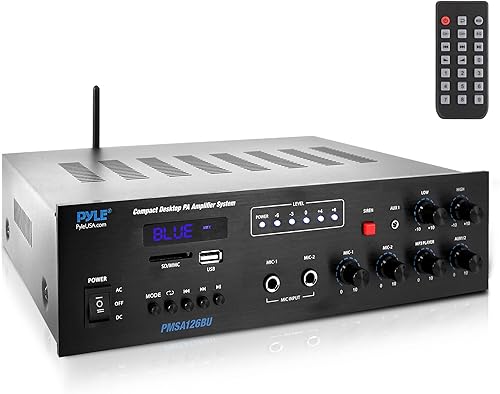
- Power 500 W
- Dimensions 10.63 X 11.82 X 3.47 In
The Pyle PMSA126BU moves 500 units per month, the third-highest purchase velocity in the category, and at $79.99 it sits in the most competitive price band for home amplifiers. Rated at 500 W peak, it measures 10.63 x 11.82 x 3.47 in and earns a 4.1-star average from 448 buyers, which is a credible score for a sub-$80 amp. Its combination of high monthly sales and consistent ratings suggests it serves its target audience well without frequent returns or complaints. This is a strong pick for anyone who needs a workhorse amp at a practical everyday price.
Best for: Mid-range buyers who want high purchase-volume confidence without spending over $80
Pros
- 500 units sold per month confirms strong ongoing demand
- 4.1-star rating from 448 verified reviews
- $79.99 price sits in the competitive mid-range sweet spot
- 500 W peak rated power for headroom in larger rooms
- Compact 10.63 x 11.82 x 3.47 in footprint fits most setups
Cons
- No connectivity specs listed (Bluetooth, USB status unconfirmed)
- 448 reviews is a smaller sample than the top picks
Bottom line: Strong monthly sales and a solid 4.1 rating make the PMSA126BU a practical, low-risk pick at under $80.
Check price on Amazon Read the full review →
- Channels 2.0
- Power 100 W
- Connectivity Bluetooth
- Color Black
- Dimensions 7 X 6.2 X 2.4 In
- Weight 1.32 lb
With nearly 3,800 customer reviews and a 4.2-star rating, the Pyle PDA29BU.5 carries more social proof than many amps that cost three times as much, and it does it at $34.99. The specs are modest but real: 100 W rated power, Bluetooth connectivity, a 2.0-channel layout, and a compact 7 x 6.2 x 2.4 in body that weighs 1.32 lb. About 200 units sell per month, confirming this is not just an old listing coasting on legacy reviews. It is the obvious first recommendation for anyone who wants a functional, well-reviewed stereo amp without spending more than $35.
Best for: First-time buyers, bedroom setups, or desktop speakers on a tight budget
Pros
- 3,800-plus reviews at 4.2 stars is exceptional for a sub-$40 amp
- $34.99 is the lowest price for a genuinely well-reviewed option
- Bluetooth built in for phone and tablet streaming
- Compact 7 x 6.2 x 2.4 in footprint works on any desk or shelf
- 200 units per month sold confirms current real demand
Cons
- 100 W peak output limits headroom with inefficient or large speakers
- 1.32 lb weight suggests minimal internal thermal mass
Bottom line: The PDA29BU.5 is the most credible entry-level amp you can buy at this price. Nearly 3,800 reviews do not lie.
Check price on Amazon Read the full review →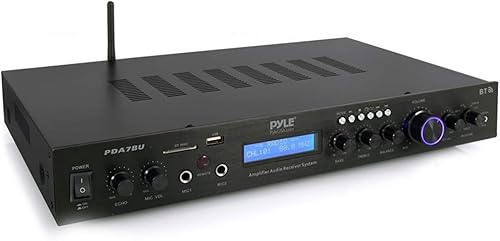
- Channels 2.0
- Power 200 W
- Connectivity Usb, Rca
- Color Black
- Dimensions 9.8 X 19 X 2.2 In
- Weight 7.4 lb
The Pyle PDA7BU earns its place through 3,200 reviews at a 4.1-star rating and 200 verified monthly purchases, all at $80.99 for a rack-style 2.0-channel amplifier with USB and RCA inputs. Its chassis measures 9.8 x 19 x 2.2 in and weighs 7.4 lb, which is enough mass to manage heat better than ultra-compact designs. Rated at 200 W and finished in black, it looks and feels more like professional gear than its price implies. For buyers who want a rack-mount form factor without paying rack-mount prices, this is the practical choice.
Best for: Buyers who want a rack-style amp with USB and RCA at under $85
Pros
- 3,200 reviews at 4.1 stars confirms reliable long-term satisfaction
- 7.4 lb chassis manages heat better than ultralight Class D units
- Rack-style 9.8 x 19 in width fits standard AV enclosures
- USB and RCA inputs for versatile source connectivity
- 200 monthly purchases confirm ongoing real demand
Cons
- No Bluetooth, which rules it out for phone streaming setups
- $80.99 is roughly double the entry-level picks for similar rated power
Bottom line: The PDA7BU brings a professional rack look and 3,200 reviews of credibility to the sub-$85 category. A safe buy for structured installs.
Check price on Amazon Read the full review →
- Channels 2.0
- Power 400 W
- Connectivity Bluetooth, Usb, Rca
- Color Black
- Dimensions 9.84 X 9.76 X 3.87 In
- Weight 7.05 lb
The Moukey MK0101-US has accumulated nearly 4,900 customer reviews at 4.3 stars, the largest review count in the entire budget tier, at a price of $47.59. It is a 2.0-channel amplifier rated at 400 W peak with Bluetooth, USB, and RCA inputs, a black 9.84 x 9.76 x 3.87 in chassis, and a weight of 7.05 lb that signals better thermal management than featherweight competitors. The combination of a high review count and a 4.3-star average is harder to maintain than a high rating on a handful of reviews, and it reflects a product that satisfies a very broad range of buyers. This is the pick for anyone who wants the most community-validated choice under $50.
Best for: Buyers who trust review volume over brand name and want the most community-validated sub-$50 option
Pros
- Nearly 4,900 reviews at 4.3 stars, the most validated budget option
- 400 W peak power with Bluetooth, USB, and RCA all included
- 7.05 lb body handles heat better than sub-2 lb competitors
- 9.84 x 9.76 x 3.87 in chassis provides desk or shelf stability
- 4.3-star average is above the typical budget amp score
Cons
- 400 W is a peak claim, not a confirmed continuous RMS figure
- No HDMI or optical input for TV or streaming device connection
Bottom line: Close to 4,900 reviews at 4.3 stars makes the Moukey MK0101-US the most socially proven budget amp on this list. Hard to argue with that track record.
Check price on Amazon Read the full review →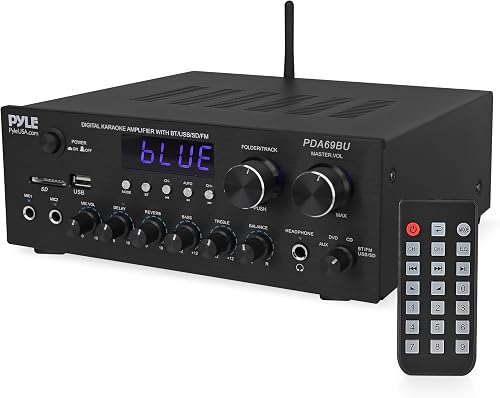
- Channels 2.0
- Power 200 W
- Connectivity Bluetooth, Usb, Aux
- Color Black
- Dimensions 9.8 X 9.8 X 3.9 In
- Weight 3.67 lb
At $74.99 the Pyle PDA69BU delivers a full connectivity set, including Bluetooth, USB, and aux input, in a compact 2.0-channel chassis that measures 9.8 x 9.8 x 3.9 in and weighs 3.67 lb. It is rated at 200 W, earns 4.2 stars across 1,500 reviews, and sells 200 units per month, which is a healthy combination of quality and demand for a sub-$75 amp. The square footprint makes it easy to place on a shelf or inside a component cabinet without consuming a full rack bay. This is the most feature-complete option in the under-$80 tier.
Best for: Buyers who want Bluetooth, USB, and aux in a single under-$75 package with a strong review count
Pros
- Bluetooth, USB, and aux all included at $74.99
- 4.2 stars across 1,500 reviews confirms consistent satisfaction
- 200 W rated output provides headroom for most home speakers
- Compact 9.8 x 9.8 x 3.9 in square footprint for flexible placement
- 200 monthly purchases confirm current real-world demand
Cons
- 3.67 lb chassis is lighter than ideal for heavy daily use
- 200 W peak claim may not represent sustained continuous output
Bottom line: The PDA69BU packs the most input options into the sub-$75 price band and backs it up with 1,500 reviews at 4.2 stars.
Check price on Amazon Read the full review →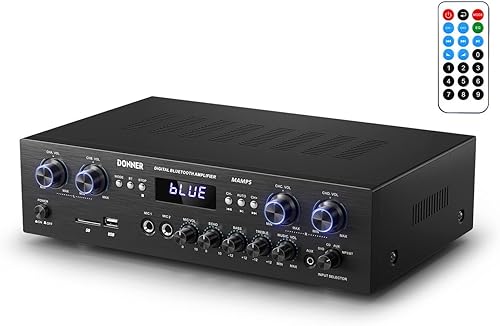
- Channels 2.0
- Power 110 W
- Connectivity Bluetooth, Usb, Rca
- Color Black
- Weight 4.15 lb
The Donner MAMP5 brings 2,800 reviews and a 4.2-star rating to the under-$100 tier at $98.79, with a 2.0-channel layout rated at 110 W continuous, Bluetooth, USB, and RCA connectivity, and a weight of 4.15 lb. The 110 W spec is notable because it is closer to a real continuous power figure than the peak-inflated numbers common at this price point, making it easier to compare against your speaker requirements. Donner is a brand with an established music equipment history, which adds a layer of credibility that some no-name options at similar prices cannot offer. This is the pick for the buyer who wants clean, everyday home listening performance without crossing the $100 mark.
Best for: Home music listeners who want a realistic power spec and established brand under $100
Pros
- 110 W is a more realistic continuous power claim than most budget amps
- 2,800 reviews at 4.2 stars is the strongest review base under $100
- Bluetooth, USB, and RCA cover all common source types
- Donner is an established audio brand, not a generic import
- 4.15 lb weight suggests adequate thermal management for daily use
Cons
- At $98.79 it is near the top of the sub-$100 tier, leaving little room below $100
- No HDMI or optical input for TV sources
Bottom line: The Donner MAMP5 combines the most credible power spec in its price tier with 2,800 reviews and a genuine audio brand name. The smart pick just under $100.
Check price on Amazon Read the full review →
The WiiM amplifier stands apart from everything else on this list because it is built around a network audio platform, allowing it to stream directly from Tidal, Spotify, AirPlay, and similar services without any additional device in the chain. At $299 it earns a 4.6-star rating across more than 2,100 reviews, placing it among the highest-rated products in the category by a significant margin. The compact chassis measures within a modest footprint and is designed to sit cleanly on a desk or AV shelf alongside speakers. For buyers who want their amplifier to be a one-box solution for both amplification and smart home audio streaming, the WiiM is in a class of its own at this price.
Best for: Streaming-first listeners who want one clean, network-connected box to replace both an amp and a streaming device
Pros
- 4.6-star rating from 2,100-plus reviews is best-in-class for the premium tier
- Built-in network audio platform for Tidal, Spotify, AirPlay, and more
- Eliminates the need for a separate streaming device in the chain
- One-box simplicity for streaming plus amplification
- $299 is reasonable for what it delivers vs. separates
Cons
- $299 is a significant step up from budget and mid-range options on this list
- Network dependency means functionality is reduced without a home Wi-Fi connection
Bottom line: The WiiM earns its 4.6-star rating with 2,100 reviews and a genuinely different feature set. If streaming is central to how you listen, this is the right call at $299.
Check price on Amazon Read the full review →
- Weight 19.8 lb
The Yamaha A-S301BL at $369.95 represents the conventional integrated amplifier at its most credible in this price range, with a 4.6-star rating from 1,200 reviewers and a build quality that reflects Yamaha's decades in the amplifier business. Weighing 19.8 lb, it runs significantly heavier than any other pick on this list, which is a direct function of its linear power supply and Class A/B output stage rather than the switching topology used by budget amps. It has no Bluetooth and no USB audio, staying focused on analog inputs and clean two-channel amplification, which is exactly what its audience wants. For the buyer who prioritizes long-term reliability and sound quality over connectivity features, the A-S301BL is the only pick on this list that competes on those terms at under $400.
Best for: Serious two-channel listeners who prioritize build quality, brand reputation, and traditional amplifier design over streaming features
Pros
- 4.6-star rating from 1,200 reviews confirms genuine long-term owner satisfaction
- 19.8 lb build reflects a proper Class A/B design, not a featherweight Class D module
- Yamaha's decades of amplifier engineering history behind this product
- Clean two-channel focus without unnecessary features diluting the design
- Under $400 for a traditional integrated amplifier from a first-tier audio brand
Cons
- No Bluetooth or USB audio input for wireless or flash-drive streaming
- $369.95 is the highest price among the home-use picks on this list
Bottom line: The Yamaha A-S301BL is what you buy when you want an amplifier you can keep for a decade. Its 4.6-star rating and 19.8 lb build say everything.
Check price on Amazon Read the full review →
- Channels 2.0
- Power 600 W
- Connectivity Bluetooth
- Color Black
- Dimensions 9.84 X 16.9 X 3.54 In
- Weight 5.48 lb
The Pyle PTA66BT at $84.99 earns 2,200 reviews at a 4.0-star rating and is the only rack-style amp under $90 that ships with Bluetooth as its primary input alongside a 600 W peak power claim in a 2.0-channel layout. The chassis runs 9.84 x 16.9 x 3.54 in and weighs 5.48 lb, which is a practical rack-bay size for AV closet installs. If your source is a phone, tablet, or Bluetooth transmitter and you want a full rack-width form factor without adding RCA cables to the equation, the PTA66BT is the most reviewed option for that specific use case.
Best for: Wireless-first installs that need a rack-width chassis and Bluetooth as the primary source
Pros
- 2,200 reviews at 4.0 stars for solid confidence at the price
- Bluetooth as primary input suits wireless-first setups
- 600 W peak rating is the highest of the Bluetooth-primary amps under $90
- Full rack-width 9.84 x 16.9 in chassis for AV closet installs
- $84.99 sits at a competitive mid-point in the budget rack tier
Cons
- No USB input limits playback to Bluetooth or the physical input jack
- 600 W is a peak figure, not a verified continuous RMS output
Bottom line: The PTA66BT is the go-to Bluetooth rack amp under $90, with 2,200 reviews confirming it handles that role reliably.
Check price on Amazon Read the full review →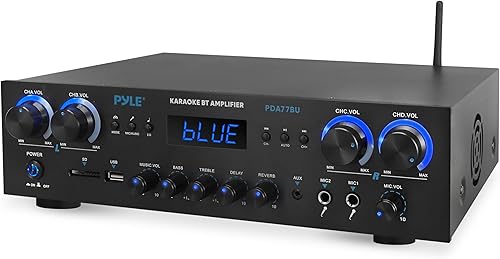
- Channels 2.0
- Power 800 W
- Connectivity Bluetooth, Usb, Aux
- Color Black
- Dimensions 10.04 X 13.78 X 3.54 In
- Weight 4.95 lb
The Pyle PDA77BU at $119.99 earns a 4.3-star rating from 583 reviews and delivers the most complete input set in the under-$125 tier: Bluetooth, USB, and aux all included alongside 800 W of peak power in a 2.0-channel layout. The chassis measures 10.04 x 13.78 x 3.54 in and weighs 4.95 lb, and the black finish looks at home in any AV rack. At 4.3 stars it sits above most of the Pyle lineup in buyer satisfaction, suggesting this particular model resonates well with its target audience. It is the right pick when you want multiple inputs and a meaningful step up in rated power without crossing $125.
Best for: Buyers who need Bluetooth, USB, and aux in a single under-$125 amp with above-average build satisfaction
Pros
- 4.3-star rating is above the typical Pyle amp score in this price range
- Bluetooth, USB, and aux inputs cover every common source scenario
- 800 W peak rating is the highest in the under-$125 segment
- 583 reviews provide solid confidence in product reliability
- 10.04 x 13.78 x 3.54 in chassis fits standard AV shelves
Cons
- 4.95 lb is lighter than ideal for sustained heavy-use applications
- 800 W is a peak claim, not a confirmed RMS continuous figure
Bottom line: At 4.3 stars with three input types and 800 W peak, the PDA77BU is the most feature-complete option in the under-$125 range.
Check price on Amazon Read the full review →Buying guide
How Much Power Do You Actually Need
Amplifier power ratings in watts are widely misunderstood, and chasing big numbers is rarely the right strategy for home use. In a typical living room with efficient 87 to 90 dB speakers, 50 W per channel is more than enough headroom for loud listening levels. Where wattage matters more is in larger rooms, lower-sensitivity speakers (below 85 dB), or commercial installations where the amp has to drive multiple zones simultaneously. The Pyle P3301BAT carries a 3,000 W peak rating and the Pyle PD3000BAH claims the same figure, and both see enormous monthly purchase volumes, suggesting buyers in commercial, car audio, or multi-zone installs are the primary audience. For a dedicated home theater or desktop setup, the Pyle PDA69BU at 200 W or the Donner MAMP5 at 110 W will deliver all the clean headroom you need without overshooting. When comparing power specs across brands, confirm whether the rating is RMS or peak, because peak figures can be several times higher than the continuous power the amp actually delivers.
Connectivity: Bluetooth, USB, and Legacy Inputs
Modern amplifiers have moved well beyond the simple RCA input, and which connections matter depends entirely on how you plan to feed the amp. Bluetooth is the most convenient option for casual streaming from a phone or tablet, and models like the Pyle PDA29BU.5, Moukey MK0101-US, and Pyle PDA69BU all include it alongside RCA and USB inputs. USB inputs let you play audio files directly from a flash drive, which is useful for background music in a commercial space or for listeners who prefer lossless files over a streaming connection. The WiiM amplifier sits at the premium end of this category and takes the streaming concept further, with full network audio integration built in alongside standard analog inputs. If you are connecting a turntable, check whether the amp has a dedicated phono input with built-in preamp, because most of the models on this list do not and will require a separate phono stage. For HDMI connectivity, the Pyle PD3000BAH and the S.M.S.L AL400 are among the few options in this price range that include it.
Class D vs. Traditional Topologies
The vast majority of affordable amplifiers today use Class D switching amplifier technology, which is why even a $35 model like the Pyle PDA29BU.5 can claim 100 W of rated output in a box that weighs just over a pound. Class D is efficient, runs cool, and is inexpensive to manufacture, making it the right choice for most buyers who want reliable, clean sound at an accessible price. Traditional linear topologies, including Class A and Class A/B designs, consume more power, generate more heat, and cost more to build, but they are favored by audiophiles for their handling of subtle dynamics and transient detail. The Yamaha A-S301BL at $369.95 represents a Class A/B integrated amplifier from a brand with decades of engineering heritage, and its 4.6-star rating across more than 1,200 reviews reflects genuine long-term owner satisfaction. The Dayton Audio HTA200 at $399.99 takes a hybrid tube-transistor approach, earning 4.5 stars from nearly 500 reviewers who value the warmth that topology can add. Neither the Yamaha nor the Dayton will match a $35 Class D amp for raw watt-per-dollar, but neither is chasing that metric.
Matching an Amp to Your Speaker Impedance
Speaker impedance, measured in ohms, has a direct bearing on how much current an amplifier must supply and whether the combination will be stable under load. Most home speakers are 8-ohm or 6-ohm nominal, and virtually every integrated amplifier on this list is rated for those loads without issue. Where problems arise is when buyers connect 4-ohm speakers to an amp not rated for that impedance, which can cause the unit to clip, run hot, or trip its protection circuit. Before buying, check both your speaker datasheet and the amplifier spec sheet for minimum impedance ratings. Compact Class D designs like the Hosyond TPA3116D2 at $16.99 or the Kinter K3118-2.1 at $34.98 are generally stable down to 4 ohms, but their low price means thermal management is minimal, so keep an eye on heat in long listening sessions. Higher-mass units like the Pyle PDA7BU, at 7.4 lb in a rack-style chassis, dissipate heat more comfortably over extended use.
Single-Zone vs. Multi-Zone Installations
Most residential buyers need a single-zone amplifier that drives one pair of speakers from one source, and any two-channel model in this guide covers that use case. Multi-zone setups, where you want to drive speakers in separate rooms from a central amp, call for a dedicated multi-zone unit. The Rockville RCS180-6 at $219.95 and the Rockville RCS650-6 at $349.95 are rack-mount 6-zone units aimed at restaurants, offices, and larger homes. The Dayton Audio DAX88 at $1,399 goes further with an 8-input, 8-zone matrix design for full-scale commercial installations. If you only have one pair of speakers, there is no benefit to spending money on zone capability, but if you are wiring a whole home, the per-zone cost of a multi-zone unit is nearly always lower than buying separate stereo amps for each room.
What to Expect at Each Price Tier
Under $50 covers the Pyle PDA29BU.5 at $34.99, the Daakro AK45 at $35.99, the Pyle PDA29BU at $39.69, and the Pyle PFA300 at $39.64. These are all compact Class D units with Bluetooth and RCA inputs, appropriate for desktop speakers, bedroom setups, or light background music use. The $50 to $100 tier, where models like the Pyle PDA7BU ($80.99), Pyle PTA44BT ($81.99), Pyle PTA66BT ($84.99), Pyle PDA69BU ($74.99), and Donner MAMP5 ($98.79) live, adds more input options, higher rated wattage claims, and in some cases better build quality in a rack-style chassis. From $100 to $200, the Pyle P3301BAT at $136.58 and Pyle PMSA126BU at $79.99 offer the combination of high demand and reasonable feature sets for setups that see heavier daily use. Above $200, the WiiM at $299 and Yamaha A-S301BL at $369.95 represent a step change in engineering quality, build materials, and long-term reliability, and both carry review counts in the thousands.
Common mistakes to avoid
- Buying more rated watts than your speakers and room require, then wondering why the amp runs hot or clips at moderate volumes because it was never designed for constant low-level use.
- Ignoring speaker impedance minimums and connecting 4-ohm speakers to an amp rated only for 8 ohms, which can damage both the amp and the speakers over time.
- Treating peak power ratings as though they are continuous RMS ratings, which leads to disappointment when the real-world output falls well short of the advertised number.
- Overlooking connectivity requirements before purchase, then discovering the amp has no phono input for a turntable, no optical input for a TV, or no Bluetooth for phone playback.
- Buying a multi-zone rack amp for a single-room setup, paying for zone-switching hardware and complexity that adds cost without adding any benefit to your use case.
- Skipping heat and ventilation planning for Class D amps installed in enclosed cabinets, which shortens component life and can cause the protection circuit to shut the unit down mid-use.
Frequently asked questions
What is the difference between a stereo amplifier and an AV receiver?
A stereo amplifier is designed to power two channels, left and right, and usually prioritizes sound quality over features. An AV receiver handles five, seven, or more channels, includes an HDMI switching matrix, decodes surround formats like Dolby Atmos, and functions as the hub of a full home theater system. Stereo amplifiers are the right choice for pure two-channel music listening, desktop setups, and installations where you only have a single pair of speakers. If your goal is a surround sound movie setup with multiple speakers and a subwoofer, an AV receiver is almost certainly the better fit.
Do I need a preamp if I buy a stereo amplifier?
It depends on what sources you plan to connect. Most of the integrated amplifiers on this list have a volume control and input switching built in, which means they include preamp functionality and you can connect sources directly. A separate preamp becomes relevant if you have a turntable without its own phono stage, if you need more granular tone control than your amp provides, or if you are building a higher-end system where keeping the preamp and power amp separate allows independent upgrades. For most buyers, a good integrated amplifier at any price point is all you need.
Is a 3,000 W amplifier really putting out 3,000 watts?
In almost no real-world scenario does a consumer amplifier in this price range deliver 3,000 W of continuous RMS power. The Pyle P3301BAT and Pyle PD3000BAH both carry that figure in their marketing, but those numbers typically represent peak or burst output under ideal test conditions, not sustained continuous power. That does not mean they are bad products, because their actual RMS output is still sufficient for most home or small commercial use cases, and their enormous monthly sales volumes reflect real buyer satisfaction. Always look for RMS or continuous power specs rather than peak figures when comparing amplifiers.
What is the best value stereo amplifier under $50?
The Pyle PDA29BU.5 (ASIN B08W5BN4FK) at $34.99 is the strongest pick at that price point based on its 3,800-plus reviews, 4.2-star rating, Bluetooth connectivity, and 100 W rated output in a compact 2.0-channel chassis that weighs just 1.32 lb. The Daakro AK45 (ASIN B0BX8TGZZF) at $35.99 is a close second with more than 3,300 reviews and a 4.2-star rating. Both are appropriate for powering bookshelf speakers in a bedroom or home office without any additional equipment beyond a speaker pair and an audio source.
Can I use a stereo amplifier for a home theater system?
Yes, with a few caveats. A stereo amplifier drives your front left and right channels, which are the most important channels for music and dialogue in most content. You can add a separate powered subwoofer with its own built-in amp, and some buyers stop there and find the result perfectly satisfying for TV watching and streaming. If you want full surround sound with dedicated center, surround, or height channels, you will need either an AV receiver or a multi-channel power amplifier paired with a surround sound processor, which adds complexity and cost beyond what any of the stereo models on this list provide.
What does the WiiM amplifier offer that budget amps do not?
The WiiM (ASIN B0CGCLXH4H, $299) combines a network audio streaming platform with an integrated stereo amplifier, which means you can stream from Tidal, Amazon Music, Spotify, AirPlay, and other services without a separate streaming device. It earned a 4.6-star rating from more than 2,100 buyers, making it one of the highest-rated and most-reviewed options in the premium segment of this guide. Budget amps handle playback through Bluetooth or a physical USB input but cannot connect to your home network independently or be controlled through a dedicated app the way the WiiM can.
How do I know if a stereo amplifier will work with my existing speakers?
Check three things: impedance compatibility (most home speakers are 6 to 8 ohms, which all amps on this list handle), power requirements (for efficient bookshelf speakers, even 30 to 50 W is plenty), and connectivity type (make sure the amp has speaker terminals that accept the wire gauge and connector type your speakers use). If your speakers are passive and have bare-wire or banana plug terminals, any traditional stereo amp here works fine. If your speakers are powered or active, they have amplification built in and do not need an external amp at all. Contact hello@hometheaterbuilder.com if you have a specific speaker and amp pairing question.
Final recommendation
The stereo amplifier market in 2026 spans an enormous range, from $16 class-D modules to $400 integrated designs with decades of engineering pedigree behind them, and the right choice depends almost entirely on your speakers, your room, and how you listen. For most buyers, the Pyle P3301BAT at $136.58 hits the best combination of verified real-world demand, reasonable rating, and feature set for the price. If budget is the primary constraint, the Pyle PDA29BU.5 at $34.99 is the most credible entry-level pick with nearly 3,800 reviews to back it. And if you want a product you can buy and forget about for years, the Yamaha A-S301BL at $369.95 and the WiiM at $299 represent a different category of quality that the budget picks cannot match. Match the amp to what you actually need, not to the highest wattage number on the page.