How to Choose a Subwoofer: A Practical Buying Guide
Recommended picks


Driver Size: The Foundation of Bass Output
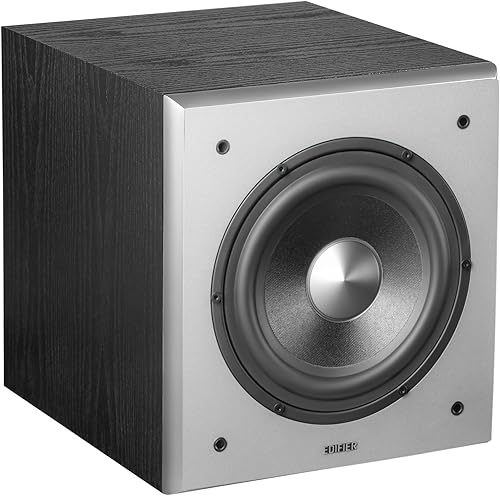
Driver size is the single biggest factor in how much low-frequency energy a subwoofer can move. An 8-inch driver, like the one in the Edifier T5 (rated at 70W and priced around $181 with 4.4 stars across 1,800 reviews), suits smaller rooms and desktop or bookshelf speaker pairings. A 12-inch driver produces more air movement and deeper extension, which is why options like the Klipsch R-12SW (400W, $259, 4.8 stars from 5,723 reviews) have become a go-to for home theater buyers. Driver size alone does not tell the whole story, though: enclosure type and amplifier power both shape how low and how loud a sub will play.
Sealed vs Ported Enclosures
Sealed cabinets are smaller, tighter, and easier to place because they roll off bass gradually and sound accurate with movie soundtracks and music. Ported cabinets use a tuned opening to extend deep bass output, making explosions and low-frequency effects more visceral in a dedicated theater room. The tradeoff is that ported subs are larger, placement matters more because port noise can color the sound near walls, and the bass rolls off more steeply below the tuning frequency. If you want a single sub that sounds musical and disappears easily into a living room, lean sealed. If your room is larger and bass impact is the priority, a ported design gives more punch per dollar.
Amplifier Power and Room Size
Manufacturers list both peak and RMS (continuous) power, and peak numbers are often inflated. Focus on RMS watts when comparing. For a 12-by-14-foot room, 100W to 200W RMS is plenty. For rooms in the 300-to-500 square foot range, look for 300W to 500W RMS. The Klipsch R-12SW lists 400W and consistently receives praise from buyers in mid-size rooms. Doubling amplifier power only adds about 3 dB of headroom, so chasing very high wattage figures matters less than matching the driver size and enclosure to the actual space.
Connectivity and System Integration
Most home theater subwoofers connect via an LFE (low-frequency effects) RCA cable from the subwoofer output on your AV receiver, which is the cleanest approach. Some models add wireless connectivity, which can help with placement when running a cable across the room is impractical. A few models, like the Sonos Sub, rely entirely on Wi-Fi and tie tightly to a specific ecosystem. Before buying wireless, confirm the subwoofer is compatible with your receiver or soundbar. Separate crossover and volume controls on the sub let you blend it with your main speakers; a good AV receiver can also set the crossover frequency automatically through room calibration, which is often the most accurate method.
Matching a Subwoofer to Your Speakers
A subwoofer handles frequencies your main speakers cannot reproduce cleanly, usually below 80 Hz to 120 Hz. Set the crossover point just above where your main speakers start to lose output. Compact bookshelf speakers often roll off around 80 Hz to 100 Hz, so a crossover setting of 80 Hz works well. Larger floor-standing speakers that reach down to 40 Hz or 50 Hz can use a lower crossover, around 60 Hz, keeping the transition seamless. Matching brand or product line is not required, but matching the general character (warm vs. tight) of your speakers helps the sub blend rather than call attention to itself.
Budget Tiers and What to Expect
Under $200, compact 8-inch models like the Edifier T5 ($181) deliver clean bass for two-channel music and casual TV watching in small rooms. In the $200-to-$400 range, 10-inch and 12-inch models offer meaningful theater performance; the Klipsch R-12SW at $259 sits squarely here with 5,723 ratings averaging 4.8 stars. Above $400, you gain more cabinet refinement, higher power reserves, wireless options, and finish quality. Beyond $700, diminishing returns set in quickly for home theater use, and room acoustics will limit what you hear more than the hardware. Prioritize spending on treating first-reflection points before upgrading to a more expensive sub.
Common mistakes to avoid
- Buying by wattage peak figures instead of RMS continuous power, which inflates perceived value.
- Placing the subwoofer in a corner for convenience without checking whether it causes boomy, one-note bass that overwhelms the room.
- Setting the crossover on the subwoofer itself instead of letting the AV receiver handle it through automatic calibration.
- Choosing a ported sub for a small room where the port resonance frequency and room modes conflict, producing uneven bass.
- Matching the subwoofer to the receiver wattage instead of the room size and speaker crossover point.
- Skipping room calibration after installation, which leaves the sub level and delay misaligned with the main speakers.
Frequently asked questions
What size subwoofer do I need for a typical living room?
A 10-inch or 12-inch subwoofer covers most living rooms in the 150-to-350 square foot range without issue. Smaller 8-inch models work in compact spaces or when paired with a soundbar. For a dedicated home theater room above 400 square feet, a 12-inch or larger driver with 300W or more keeps bass pressurized at realistic listening levels.
Should I get a sealed or ported subwoofer?
Sealed subwoofers roll off gradually below their extension point and sound tight and accurate, making them a solid choice for music and movies in most rooms. Ported designs extend deeper bass output and sound more impactful for action films and large rooms, but require more careful placement. If you are not sure, sealed is easier to integrate and harder to place wrong.
How do I connect a subwoofer to my AV receiver?
Run a single RCA cable from the subwoofer pre-out jack on your AV receiver to the LFE input on the subwoofer. Set the subwoofer volume to about the midpoint, then run your receiver's automatic room calibration to set the level and distance precisely. Avoid relying on the subwoofer's own crossover dial if the receiver handles bass management, as two active crossovers can create phase problems.
Does brand matter when choosing a subwoofer?
Brand matters less than specifications and buyer feedback at a given price point. Klipsch, Edifier, SVS, and Polk Audio are widely trusted names with strong track records, but lesser-known brands can deliver solid performance at lower prices. Focus on driver size, RMS power, enclosure type, and verified reviews from buyers who use the sub in a setup similar to yours.
Can I use one subwoofer with a soundbar?
Yes, but confirm compatibility before buying. Many soundbars include a wireless subwoofer in the box or pair only with a matching sub from the same brand. If your soundbar has a dedicated subwoofer output, a passive or powered sub with the right connector works. For fully wireless setups like Sonos, the ecosystem is closed and only Sonos subs pair seamlessly. Contact us at hello@hometheaterbuilder.com if you need help matching a specific soundbar and sub combination.