Where to Place a Subwoofer for the Best Bass
Recommended picks


Why Placement Matters More Than You Think
A room does not treat all bass frequencies equally. Low frequencies build up in corners and along walls, and they cancel out at certain distances from those surfaces. Put your subwoofer in the wrong spot and you get boomy, one-note bass or a complete null at your couch. The same subwoofer in a better location can sound dramatically cleaner. This is why two buyers with identical gear can have very different results. Room acoustics, not the subwoofer's power rating, are usually the limiting factor.
The Subwoofer Crawl: How to Find the Best Position
The subwoofer crawl is the most reliable placement method for any room. Place your subwoofer temporarily at your main listening position, play a bass-heavy track on a loop, then slowly crawl around the perimeter and front wall while listening. The spot where the bass sounds clearest and most even is where you should put the subwoofer permanently. It works because bass behavior is reciprocal: a spot that sounds good to your ears at floor level will also sound good when the sub is placed there and you sit in your chair. This takes about ten minutes and costs nothing.
Front-Wall Placement and Corner Loading
Most home theater builders get the best results placing the subwoofer along the front wall, between the left and right main speakers or just to one side of the TV cabinet. This position keeps the sub close to the main speakers so bass transitions sound coherent rather than coming from a different part of the room. Pushing the subwoofer into a front corner adds boundary reinforcement, which can extend low-frequency output by several decibels. Corner placement works well for larger rooms where you need more output, though it can also emphasize one-note boom if the sub's low-pass filter and volume are not dialed back slightly to compensate.
Side-Wall and Behind-the-Couch Placement
Side-wall placement can work in rooms where the front wall is fully occupied by cabinetry, but it often creates a localization problem where bass seems to pull toward one side of the room. If you go this route, keep the subwoofer within the front two-thirds of the room rather than pushing it all the way back. Behind-the-couch placement, while occasionally recommended, tends to produce bass that sounds disconnected from on-screen action. It can work with a wireless subwoofer in a room where cables across the floor are not practical, but it usually requires more adjustment to avoid a bloated low-midrange quality.
Setting the Crossover and Volume After Placement
Once you have settled on a position, set the crossover frequency on the subwoofer to match your main speakers. If your mains go down to around 80 Hz, a crossover point of 80 Hz is a reasonable starting point. If you are using a receiver with Audyssey, MCACC, or another room correction system, run that calibration after the subwoofer is in its final position, because it adjusts for the acoustic properties of the specific location. Volume should be set so bass fills the room without overpowering dialogue. A common mistake is running the sub too loud to compensate for a poor position.
Subwoofers Worth Considering for Home Theater
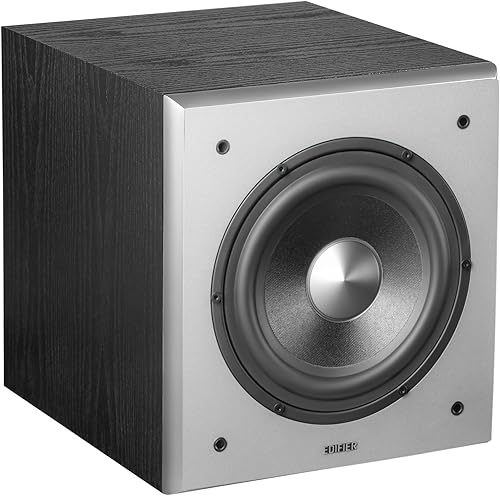
The Klipsch R-12SW (ASIN B00MJ1YR8Y) is one of the most popular floor-standing home theater subwoofers available, rated 4.8 stars across more than 5,700 reviews, priced at $259 with a 400W amp and a 12-inch driver. It is compact enough to fit beside a media cabinet without dominating the room. The Edifier T5 (ASIN B07Z58GD12) is a smaller option at $181 with a 70W amp and an 8-inch driver, rated 4.4 stars by 1,800 buyers, and its tabletop-friendly footprint makes side-wall or shelf placement practical in tighter spaces. For larger rooms where corner loading alone is not enough, the Klipsch R-120SW (ASIN B07FK2WNW4) carries 4.8 stars from over 2,800 reviews at $329. Questions about any of these? Email hello@hometheaterbuilder.com.
Common mistakes to avoid
- Placing the subwoofer in the middle of the room, which often creates a bass null at the listening position.
- Hiding the subwoofer inside a cabinet or enclosed entertainment center, which muffle output and can cause the cabinet to rattle.
- Running the subwoofer volume too high to compensate for a bad position instead of moving it first.
- Setting the crossover too high, which makes the subwoofer audibly localizable and causes it to overlap with the midrange output of your main speakers.
- Skipping room correction calibration after moving the subwoofer to a new location, which leaves old delay and EQ settings in place.
- Placing a ported subwoofer with its port facing a wall with less than 6 inches of clearance, which chokes airflow and can distort bass output.
Frequently asked questions
Can I place my subwoofer behind the TV?
Yes, and many builders do exactly that. Tucking the subwoofer behind or below the TV keeps it near the front wall, which is generally the best zone for bass integration with your main speakers. Just make sure there is enough clearance around any ports, typically at least 6 inches from the nearest wall or surface, so airflow is not restricted.
Does a subwoofer need to be on the floor?
Floor placement is standard because it takes advantage of floor-boundary reinforcement and keeps the heavy cabinet stable. That said, some compact subwoofers can sit on a shelf or cabinet without problem. If you use a shelf, make sure it is sturdy enough to handle both the weight and the vibration. Elevated placement removes the floor-boundary gain, which may slightly reduce maximum output at the lowest frequencies.
Should my subwoofer be on the same side as the left or right speaker?
It does not make a meaningful difference for most listeners, because bass frequencies below 80 Hz are largely non-directional and the brain cannot pinpoint where they originate. What matters more is whether the placement produces even bass at your listening seat, which you find by doing the subwoofer crawl. If you have two subwoofers, one on each side of the front wall is the textbook arrangement for the smoothest in-room response.
Will putting the subwoofer in a corner damage it?
No, corner placement does not damage a subwoofer. It increases boundary reinforcement, which raises output levels. The only practical concern is that more output can expose distortion if the subwoofer volume and crossover are not adjusted down slightly to keep the sound balanced. Corner placement is a legitimate and widely used technique, not a workaround.
How far should the subwoofer be from the listening position?
There is no single correct distance. What matters is that the arrival time of bass from the subwoofer matches the arrival time of bass from your main speakers, which your AV receiver's room correction system or manual delay settings handle automatically. In a typical living room, distances of 8 to 20 feet between the subwoofer and the couch are common and work fine once delay is calibrated.