What Is Dolby Atmos Surround Sound?
Recommended picks


How Dolby Atmos Differs from Standard 5.1 and 7.1
A conventional 5.1 system places five speakers in a horizontal plane around the listener, plus one subwoofer, giving you front, center, left surround, and right surround channels. Dolby Atmos keeps that foundation and adds height channels, typically labeled with a third number: a 5.1.2 system has two height speakers, a 5.1.4 has four. The Klipsch 1069177 is sold as a 5.1.4 surround system at $549, meaning it covers the full horizontal plane and has four Atmos-capable height positions in one package. That vertical layer is what separates Atmos from legacy formats, letting a helicopter fly overhead rather than just panning side to side.
Object-Based Audio: What It Actually Means
Traditional surround sound assigns instruments and effects to a specific channel track on the recording. Dolby Atmos stores each sound as a metadata object with position coordinates, and the receiver or soundbar calculates in real time which speakers should reproduce it at what volume. This means the same Atmos mix can be played on a 5.1.2 home setup, a 9.1.4 cinema rig, or a stereo pair with virtual processing, and each will reproduce the intent as accurately as possible. The mix adapts to the hardware you have rather than being locked to one speaker count.
What Hardware You Need for Real Atmos Playback
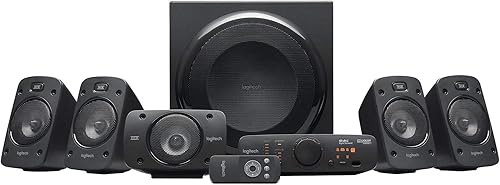
To get genuine Atmos audio you need three things: an Atmos-encoded source, an AV receiver or soundbar that decodes Atmos, and speakers that address the height plane. Height speakers come in two forms: upward-firing add-on modules that bounce sound off your ceiling, or actual in-ceiling or ceiling-mounted speakers. The Klipsch R-41SA (B07FKCP7PY) is a dedicated Atmos elevation speaker at $159.99 with a 4.7 rating across 1,300 reviews, designed to sit on top of your existing front speakers and fire upward. A flat-wall 5.1 setup like the Logitech 980-000467, which covers 5.1 channels at $402.99 with 5,900 reviews and a 4.5 rating, will not reproduce true Atmos height unless you add upward-firing or ceiling units. If your receiver does not decode Atmos natively, height-channel information is simply ignored.
Atmos Sources: Where the Content Comes From
Dolby Atmos content arrives through several paths. 4K Blu-ray discs carry full lossless Atmos tracks, which is the highest quality available. Streaming services including Netflix, Apple TV Plus, Disney Plus, and Amazon Prime Video offer Atmos streams, though the bitrate is compressed compared to disc. Gaming consoles support Atmos pass-through for both games and streaming apps. The source player and the HDMI cable connecting it to your receiver both need to support HDMI 2.0 or later and eARC on the TV side to carry an Atmos bitstream correctly. Optical connections cannot carry Atmos, so they are not suitable for height-channel setups.
Atmos in Soundbars vs. Dedicated Speaker Systems
Many soundbars advertise Dolby Atmos support through built-in upward-firing drivers that reflect height audio off your ceiling. The effect varies based on ceiling height and material: a flat, low ceiling at 8 feet works better than vaulted or irregular surfaces. Dedicated discrete speaker systems deliver more convincing height separation because each driver is aimed precisely at the listener. The tradeoff is cost and cable management. A true 5.1.4 speaker system priced around $500 to $1,200 will generally outperform a soundbar-only Atmos solution in a dedicated home theater room, but a well-placed Atmos soundbar can work acceptably in a living room with a standard ceiling.
Room Setup and Calibration Basics
Height speaker placement is the single biggest factor in whether Atmos sounds convincing. Dolby recommends front height speakers at 45 degrees above the main listening position and rear height speakers at the same elevation directly behind you. Ceiling height between 8 and 14 feet gives the best results with upward-firing modules. Most AV receivers include an automatic speaker calibration system, such as Audyssey, YPAO, or MCACC, that measures speaker distance, level, and room response using a microphone. Running calibration after you install your speakers is not optional if you want accurate Atmos localization. Skipping it typically results in height sounds that appear to come from the wrong position or at uneven volume levels.
Common mistakes to avoid
- Connecting Atmos sources via optical cable, which cannot carry the Atmos bitstream and silently downgrades the audio to 5.1 or stereo.
- Buying Atmos-capable speakers but pairing them with a receiver that has no Atmos decoder, so height channels are never processed.
- Skipping automatic room calibration after installing height speakers, leaving distance and level offsets uncorrected.
- Placing upward-firing Atmos modules under a vaulted, angled, or heavily textured ceiling where reflections scatter unpredictably.
- Expecting full Atmos from a TV's built-in speakers, which never carry height channels regardless of the TV's marketing language.
- Confusing virtual surround processing with real Atmos, which requires actual overhead sound sources to create genuine height separation.
Frequently asked questions
Do I need a special TV for Dolby Atmos?
The TV itself does not decode Atmos. What matters is that your TV has an eARC-enabled HDMI port so it can pass an Atmos bitstream from a streaming app to your AV receiver or soundbar. Most TVs sold since 2019 include at least one eARC port, typically labeled on the port itself. Standard ARC passes only compressed audio and cannot carry the full Atmos object data.
Can my existing 5.1 speakers play Dolby Atmos?
A standard 5.1 setup without height speakers cannot reproduce true Atmos height channels. However, a compatible AV receiver can apply DTS Virtual:X or Dolby Atmos virtual processing to simulate height from your existing speakers, which gives some sense of verticality without adding physical drivers. Real overhead sound requires upward-firing modules or ceiling-mounted speakers connected to your receiver's height amplifier channels.
Is Dolby Atmos worth it for a budget home theater?
Entry-level Atmos upgrades, such as adding a pair of upward-firing elevation speakers to an existing 5.1 system, typically cost $100 to $200 and make a noticeable difference on action films with dedicated Atmos mixes. If you are starting from scratch with a tight budget, a solid 5.1 system at $300 to $500 will outperform a cheap Atmos-branded setup because speaker and subwoofer quality matter more than channel count at the lower price tier.
What does 5.1.2 or 5.1.4 mean on a speaker system?
The three-number format describes main channels, subwoofers, and height channels in that order. A 5.1.2 system has five horizontal speakers, one subwoofer, and two height speakers. A 5.1.4 adds two more height positions, usually a front pair and a rear pair, for a more complete overhead envelope. The Klipsch 1069177 is rated at 5.1.4, covering all four height positions in a single system package priced at $549.
Does streaming Atmos sound as good as Blu-ray Atmos?
No. Streaming services encode Atmos over compressed Dolby Digital Plus at bitrates typically between 768 kbps and 1.5 Mbps, while a 4K Blu-ray carries lossless Dolby TrueHD Atmos at up to 18 Mbps. The height-channel metadata is present in both cases, so the three-dimensional placement works the same way. The audible difference shows up in fine detail, dynamic range, and low-level ambience rather than in the positional effects themselves. For casual viewing, streaming Atmos is perfectly adequate; for a dedicated home theater focused on sound quality, disc playback is noticeably better.