How Many Watts Per Channel Do I Actually Need?
Recommended picks


Why Wattage Numbers Are Often Misleading
Manufacturers measure power ratings under controlled conditions that rarely match your living room. A receiver claiming 100 watts per channel may achieve that figure driving only two channels at a specific test frequency, not all channels simultaneously. The Onkyo TX-SR494, rated at 160 watts per channel, drew over 630 buyer reviews and a 4.3-star rating partly because its real-world output sounds cleaner and more dynamic than cheaper, higher-number competitors. The takeaway is to look at reviews and brand reputation alongside wattage specs, not wattage alone.
Room Size Is the Biggest Factor
A small bedroom theater of 150 to 200 square feet needs far less power than a dedicated 500-square-foot screening room. Sound pressure drops by about 6 dB every time you double the distance from the speakers, so a bigger room demands more reserve power to fill corners and avoid audible compression at loud moments. For rooms under 300 square feet, 50 to 80 watts per channel is rarely a limit. Rooms in the 400 to 800 square foot range benefit from 80 to 120 watts. Larger dedicated rooms should target 120 watts or more per channel, and even then speaker placement matters as much as raw power.
Speaker Sensitivity Changes the Math Entirely
Sensitivity is measured in decibels at 1 watt from 1 meter, and it has a dramatic effect on how much amplifier power you actually need. A speaker rated at 90 dB sensitivity produces the same volume with 1 watt that a 84 dB speaker produces with 4 watts, a fourfold difference. If your speakers are 89 dB or higher, a receiver with 80 to 100 watts per channel gives you plenty of headroom. If your speakers dip below 86 dB, jumping to 100 to 150 watts per channel is a practical move. Always check your speaker spec sheets before buying a receiver and treat sensitivity as a higher priority than wattage class.
How Listening Volume Affects Your Real Power Need
Most people listen at conversation level, which sits around 70 to 75 dB at the listening position. Achieving that level in a typical room requires only 1 to 5 watts per channel from the receiver. Even theatrical reference level, which is 85 dB average with 105 dB peaks, demands only 10 to 20 watts of continuous power, though peaks can momentarily spike much higher. The headroom above your average listening level is what wattage actually buys you, so a receiver with 80 to 100 watts gives you roughly 10 to 13 dB of clean headroom above that conversation-level baseline. That covers nearly every realistic use case short of a dedicated high-volume screening room.
Matching Watts to Channel Count
A 7.2 or 9.2 channel receiver shares its power supply across all active channels at once. When all channels fire simultaneously during a movie surround effect, each channel draws from the same power reserve. This is why a 7-channel receiver rated at 80 watts per channel does not simply deliver 560 watts total on demand. For surround sound use, 80 to 100 watts per channel in a 5.1 or 7.1 receiver covers most home theaters well. If you plan to drive ceiling speakers for Dolby Atmos height channels, those channels see lighter use than front mains, so the same wattage figure handles them without issue.
When More Watts Are Actually Worth It
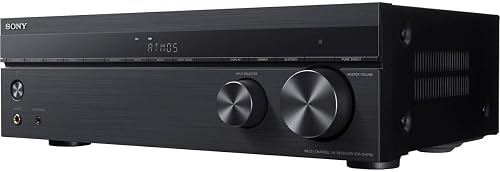
Two scenarios justify stepping up beyond 100 watts per channel. First, planar magnetic or electrostatic speakers with low sensitivity and complex impedance loads need a more capable amplifier to prevent clipping at moderate volumes. Second, if you run a large party or home bar setup where you want sustained high volume for extended periods, additional headroom keeps the amplifier from running hot and compressing dynamics. Outside those cases, spending extra budget on better speakers, room treatment, or a more versatile receiver with superior processing is usually a smarter call than chasing watt counts. The Sony STR-DH790, one of the most reviewed AV receivers with over 3,000 ratings at 4.3 stars, is a good example of a model that earns trust through real-world balance rather than headline power specs.
Common mistakes to avoid
- Choosing a receiver based only on peak wattage without checking how that figure was measured or under what test conditions.
- Ignoring speaker sensitivity, which can matter more than amplifier wattage when it comes to actual loudness.
- Buying a high-wattage receiver for a small room where 50 watts per channel would already be more than enough.
- Assuming more channels means more power, when sharing a power supply across 7 or 9 channels reduces what each channel gets simultaneously.
- Confusing peak power with RMS power. RMS is the continuous rating you should compare across brands.
- Overlooking impedance matching. Running 4-ohm speakers on a receiver rated only for 8-ohm loads can stress the amplifier far more than the wattage spec suggests.
Frequently asked questions
Is 80 watts per channel enough for a home theater?
For most setups, yes. A receiver putting out 80 watts per channel, like the Yamaha RX-V4ABL, handles rooms up to roughly 500 square feet with 87 dB or higher sensitivity speakers without breaking a sweat. You would only run short on headroom with very large rooms, low-sensitivity speakers, or sustained high-volume listening sessions.
Does doubling the wattage make the sound twice as loud?
No. Doubling amplifier wattage adds only 3 dB of volume, which is a modest, real but not dramatic difference to the ear. To gain a noticeable 10 dB increase you would need to multiply power by 10. This is why jumping from 80 to 160 watts per channel rarely sounds like a major upgrade in practice.
Can a receiver with too many watts damage my speakers?
Yes, but the risk is usually from clipping rather than from watts alone. A clean 150-watt signal is safer for most speakers than a distorted, clipping 50-watt signal. Match the receiver's power ceiling to your speakers' rated power handling range and avoid pushing the volume into audible distortion, which is where damage actually happens.
What wattage do I need for a 5.1 home theater in a living room?
A living room 5.1 setup in the 250 to 400 square foot range typically works well with 80 to 100 watts per channel. The Onkyo TX-SR494, rated at 160 watts per channel and priced around $499, gives you more headroom than most living rooms will ever use, making it a reliable choice if you also plan occasional high-volume movie nights.
Should I pay more to get a higher-wattage receiver?
Not automatically. The practical gains from 80 to 120 watts per channel are real but modest, and the cost jump is often steep. If your budget allows, prioritize better room correction software, more HDMI inputs, or improved audio decoding support over raw wattage gains. Contact us at hello@hometheaterbuilder.com if you want a specific recommendation for your room size and speakers.